
The complete guide
How to Choose a Gesture Control Stunt Car That Actually Gets Played With
The toy that gets five minutes and then lives under the bed
Every family has one. A remote control car that looked brilliant in the box, got driven up and down the hallway twice, and then went quiet. Usually it is not the child's fault. It is the car. A basic RC car does one thing, and once you have done that thing, there is nothing left to discover.
The problem is that driving in a straight line is not actually that interesting after the first day. What holds attention is a toy that lets a child get better at something. That means it has to do more than one thing, and the things it does have to be a bit hard at first.
A gesture control stunt car works on exactly that principle. There are two completely different ways to drive it, and each one takes practice. The tricks it can pull off are not automatic, they come from learning how the car behaves. That is what turns a toy into a hobby, even a small one.
How gesture control works, in plain terms
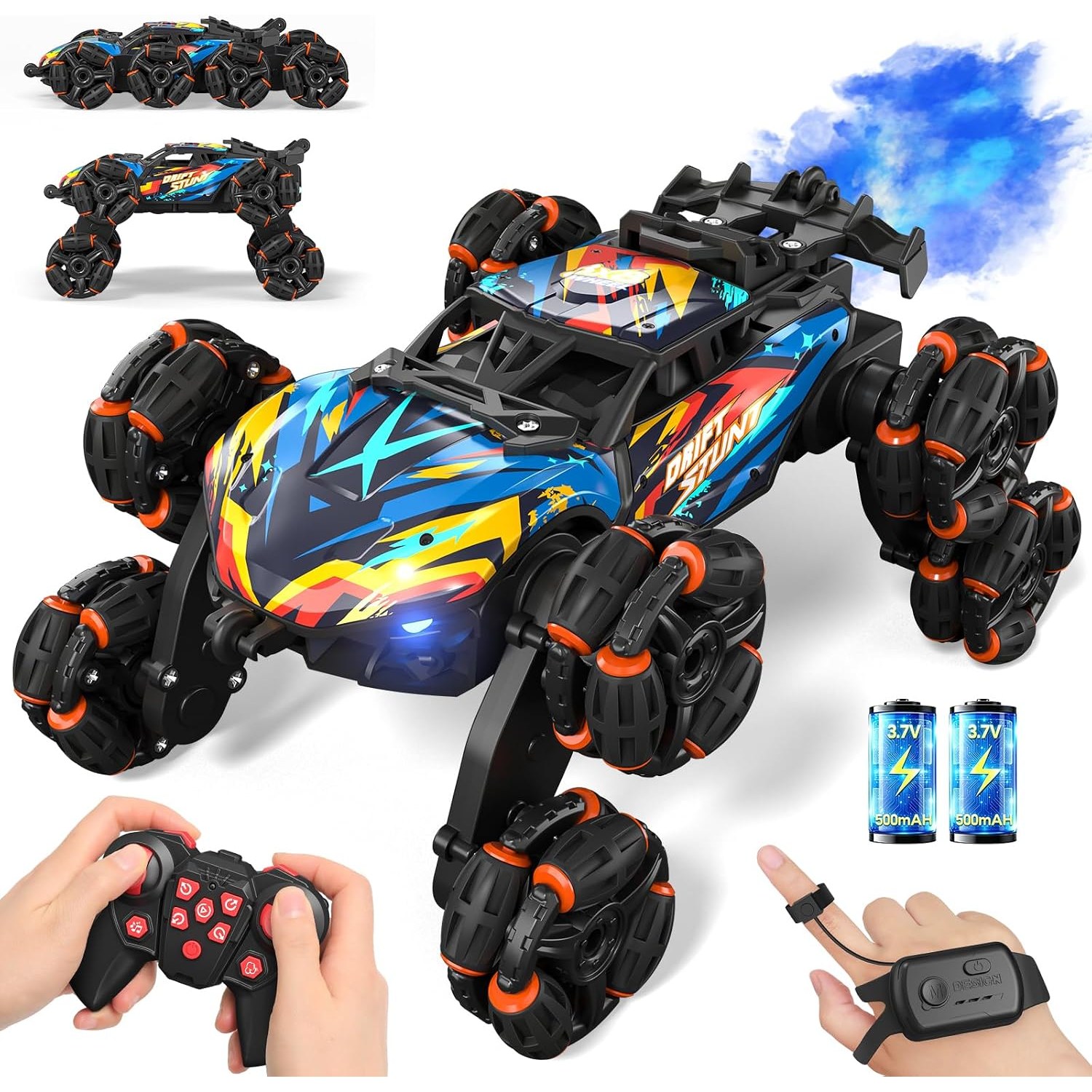
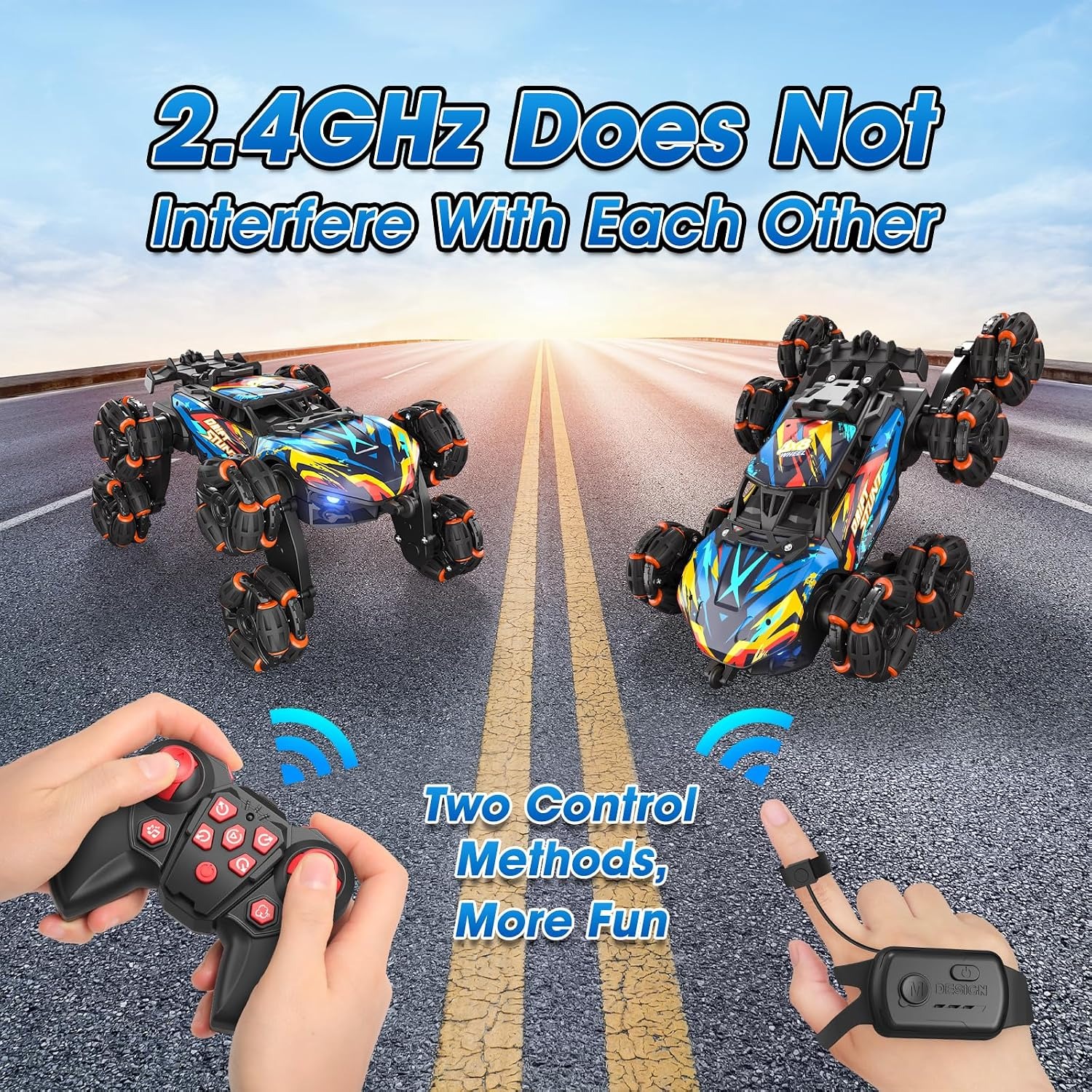
The idea sounds more complicated than it is. You wear a small sensor on your wrist, a bit like a watch. Inside is a tilt sensor that notices which way your hand is pointing. Tip your hand forward and the car drives forward. Lean it back and the car reverses. Tilt left or right and it turns that way.
The signal goes to the car over the same 2.4GHz wireless link the handset uses. There is no camera involved and nothing to point at, so it works in a dim room just as well as a bright one.
What surprises most people is how fast young children take to it. A handset asks a child to translate two thumbsticks into movement on the floor, which is a learned skill. Gesture control removes that translation step. You move your hand, the car moves. Three and four year olds often get it in under a minute, while the same child might struggle with a twin-stick controller for a week.
The handset still matters though. Once a child wants precision, like threading between chair legs or holding a long drift, fingers beat wrists every time. Having both modes in one toy means the car grows with the child rather than being outgrown.
What the 8WD layout is for
Eight driven wheels on a car this size is not just a spec sheet number. It changes what the car can do.
With four wheels, lifting two off the ground usually means you have stopped. With eight, there is almost always something touching the floor and pushing. That is how the car climbs over a door threshold, a garden hose, or the edge of a rug without needing a run-up.
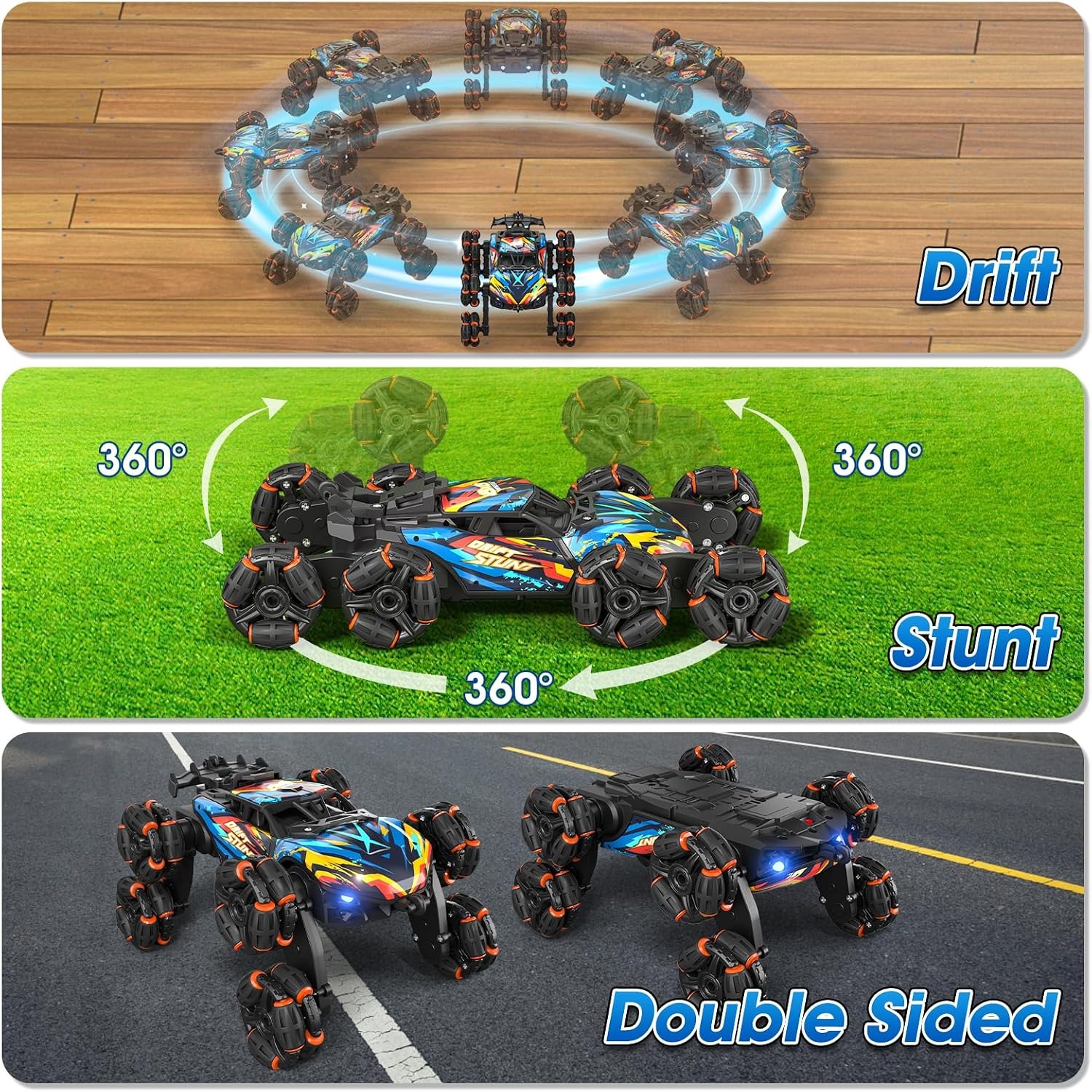
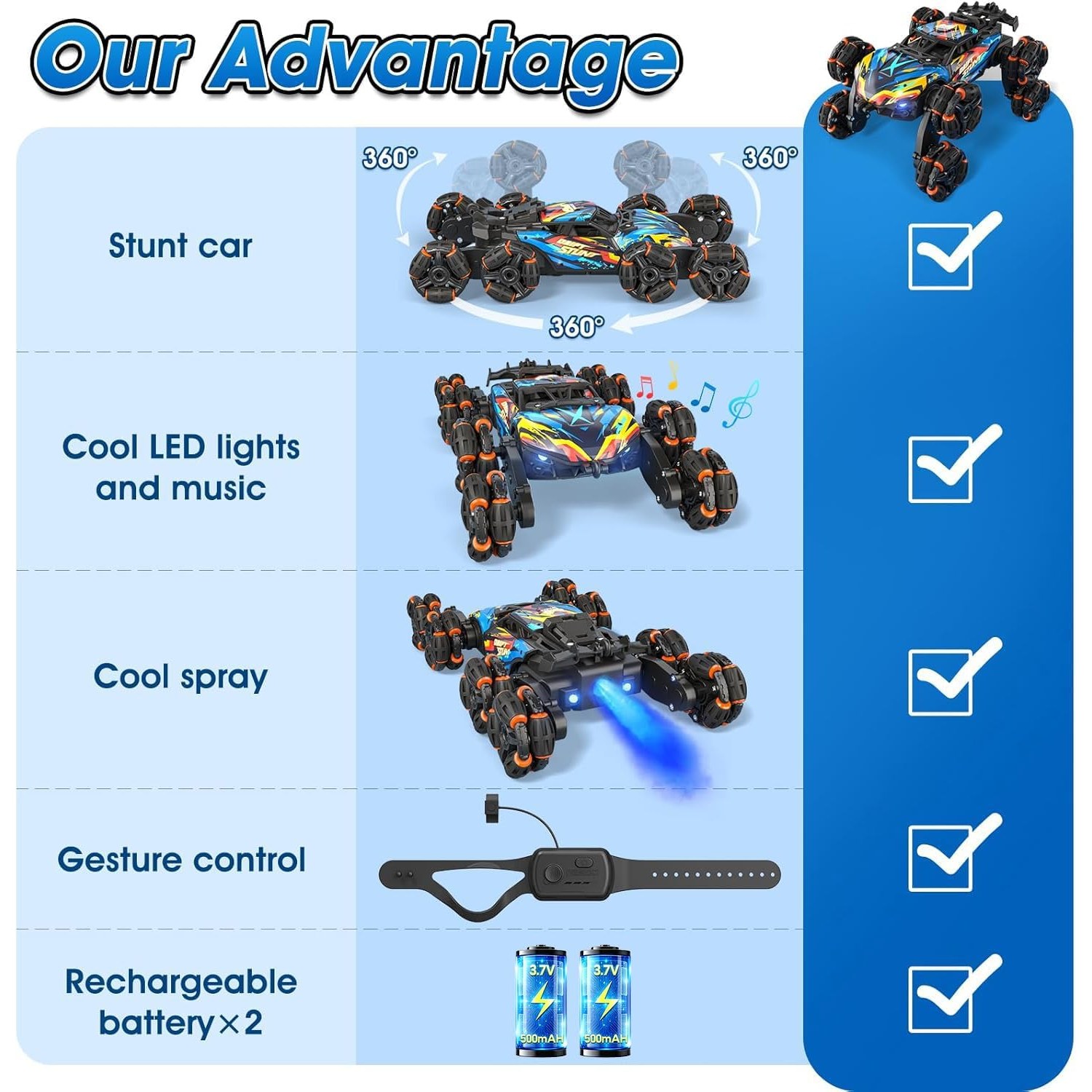
Then there are the arms. The front and rear wheel pairs sit on arms that rotate a full 360 degrees. When those arms turn, the car can flip itself over, lift its nose, or spin on the spot. Because it is double-sided, landing upside down is not a problem. The car just carries on driving, which saves a lot of running across the lawn to turn it the right way up.
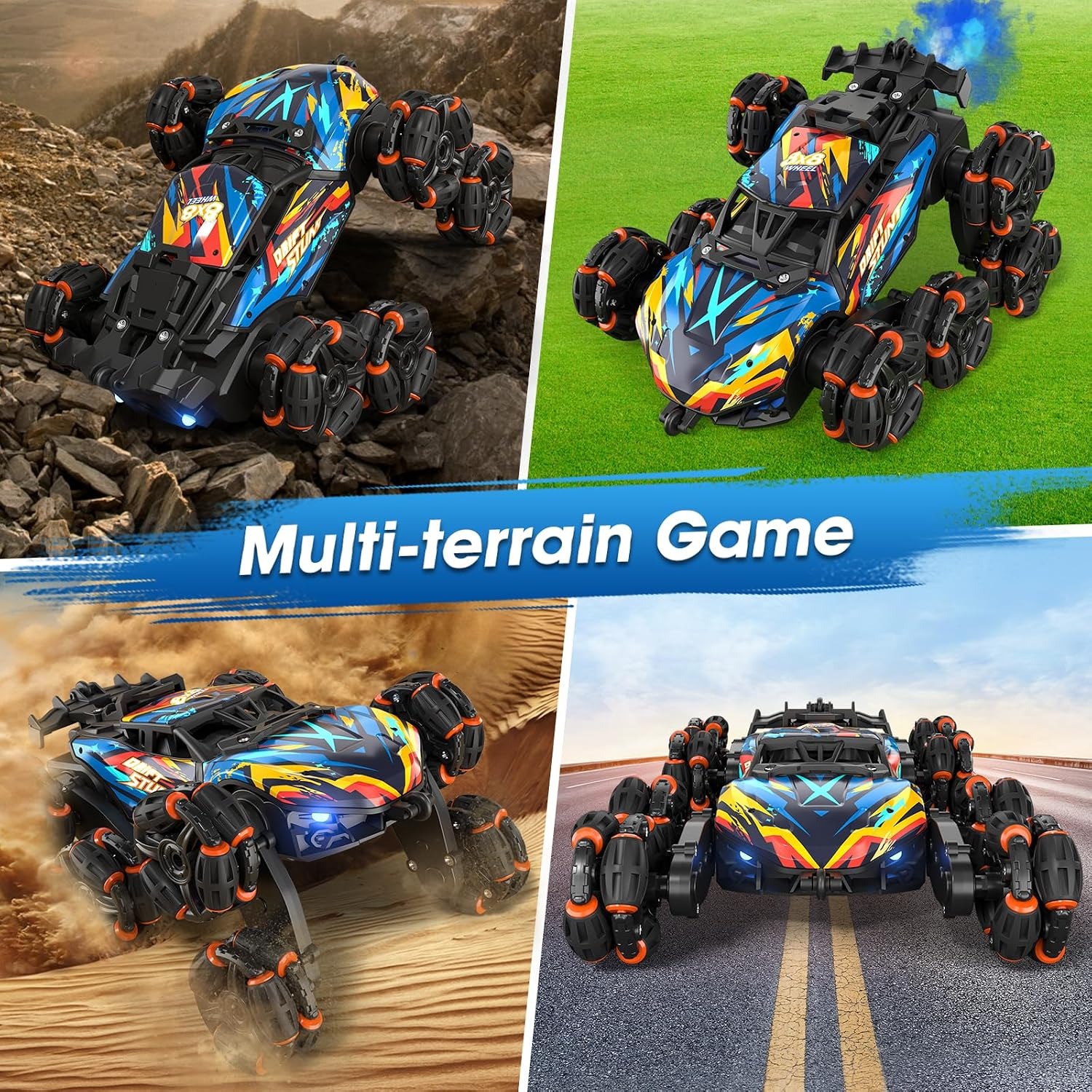
Road mode and off-road mode switch between settings suited to smooth surfaces and rougher ground. On hard floors the wheel design lets the car slide rather than grip, which is what gives you the drift. Outside on grass or sand, the eight-wheel drive does the work instead.
Who it suits
The recommended age is 36 months to 12 years, which is a wide span, and the two control modes are the reason it stretches that far.
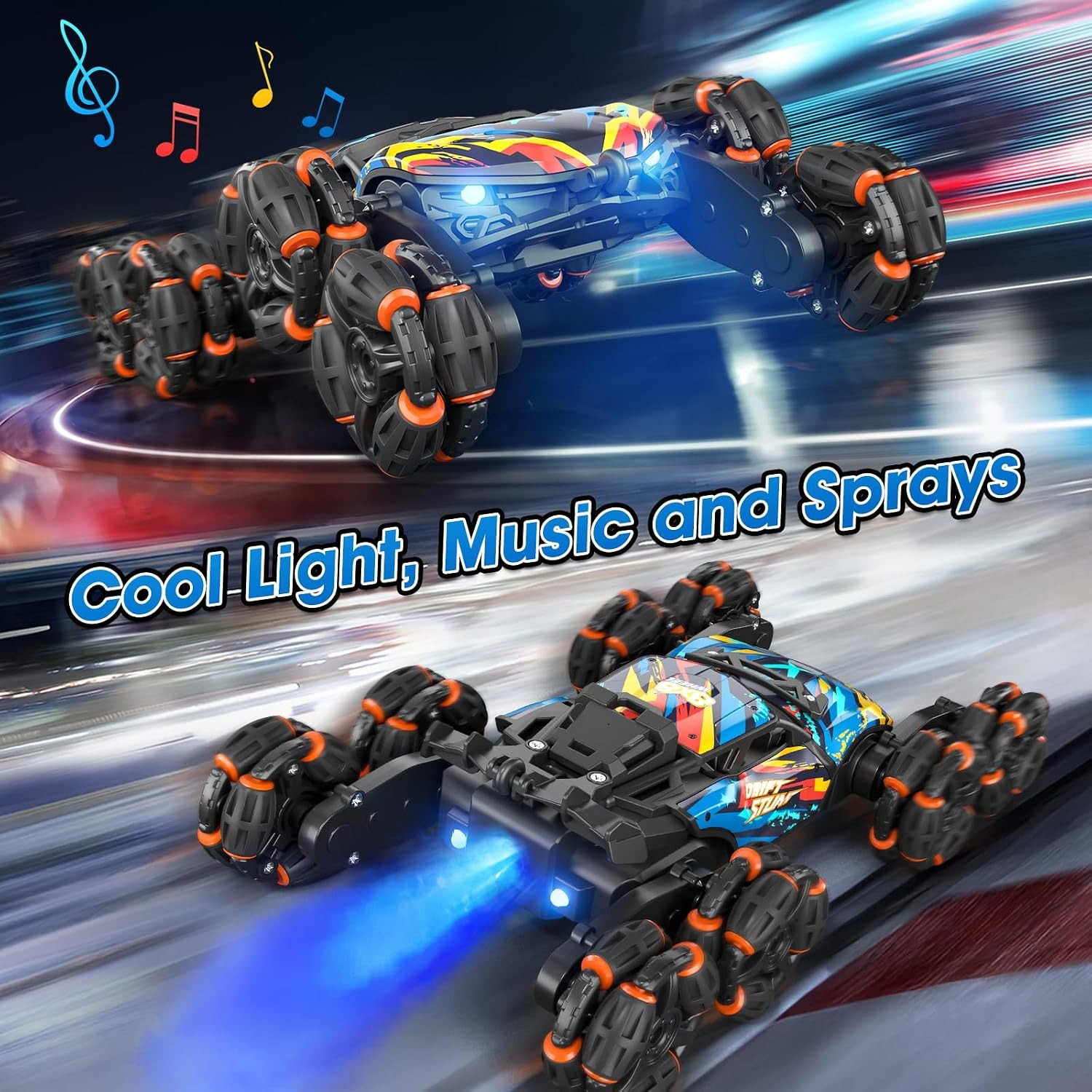
At the younger end, around three to five, the appeal is the gesture sensor plus the lights, the music and the spray. Children that age want cause and effect. Hand moves, car moves, lights flash. The automatic driving mode is useful here too, because the car performs on its own while the child watches and copies the movements.
From six to eight, the handset starts getting used more. This is where kids begin aiming at targets, setting up obstacle courses out of shoes and books, and trying to land a flip on purpose rather than by accident.
Nine and up is drift territory. On a smooth kitchen or garage floor, a car with slick wheels and eight-wheel drive will slide through corners in a way that looks genuinely good. Older children also tend to be the ones who want to race, and the anti-interference 2.4GHz system means two or more cars can run in the same space without fighting over the signal.
It is also worth saying this works for mixed ages. One child on the handset, one wearing the sensor, both driving at once. That solves a lot of arguments.
Choosing well, and what to check
If you are comparing stunt cars, a few things separate the ones that last from the ones that do not.
Build material is the first. This one uses ABS plastic with an alloy iron plate inside. ABS is the standard for toy vehicles because it flexes slightly instead of shattering, and the metal plate gives the chassis something solid to hold together when the car lands hard. A stunt car spends its life crashing, so this is not a small detail.
Battery arrangement is the second. Check what is included before you buy. Here the rechargeable lithium-ion pack for the car and the two AA batteries for the handset are both supplied, so nothing needs buying on the day. Many people looking for the best rechargeable RC car find that out the hard way when the handset batteries are missing.
Noise control is the third, and parents care about it more than the box suggests. Three music tracks, engine sounds and a spray effect are fun for the first hour. Being able to switch the music and spray off is what makes the toy survive a rainy Sunday indoors. That option is built in here.
Size is the last one. At 24 x 16 x 6.5 cm and 0.84 kg, this is a mid-size toy. Big enough to handle grass and gravel, small enough to drive inside without redecorating the living room.
Keeping it running
Stunt cars live rough, so a small amount of care goes a long way.
Wipe the body down after outdoor use and dry it properly before putting it away. Grit is the real enemy, not dirt. It works into the wheel arms and makes the rotating mechanism stiff, so check around the axles and pull out any sand, hair or carpet fibres you find.
Empty the spray reservoir if the car is going into a cupboard for a few weeks. Keep the lithium-ion battery topped up rather than letting it sit flat for months, and charge it with an adult nearby. Take the AA cells out of the handset during long storage so they cannot leak.
Treat it as a dry-use toy. Water resistance is not listed for this model, so puddles, wet grass and the beach are best avoided.
The short version
If you want an RC car that holds attention past the first week, pick one that can be driven more than one way and can do more than drive. This one has a wrist sensor and a 2.4GHz handset, eight driven wheels, arms that rotate all the way round, and a body that drives either way up. Add LED lights, music, engine sounds and a spray effect that can all be dialled back when you need quiet, and you have a toy that suits a three year old and a ten year old for different reasons.
Everything comes in the box, including batteries, and there is nothing to assemble. Charge it, fit the AA cells, and go.