
The complete guide
How To Choose An Animal Figure Set That Actually Gets Played With
The problem with most animal toys
Walk into almost any family home and you will find animal figures. A lion in the car door pocket, a zebra at the bottom of the toy box, a giraffe that somehow ended up in the bathroom. They arrive in bags of twelve or twenty, they get tipped out, and then they get scattered. Nobody throws them away, but nobody really plays with them either.
The reason is simple. A figure on its own has nowhere to be. A child picks up a lion and then has to invent the ground, the trees, the water hole and the whole situation from nothing. Some children happily do that. Plenty of others look at the pile, do not know where to start, and move on to something with more structure.
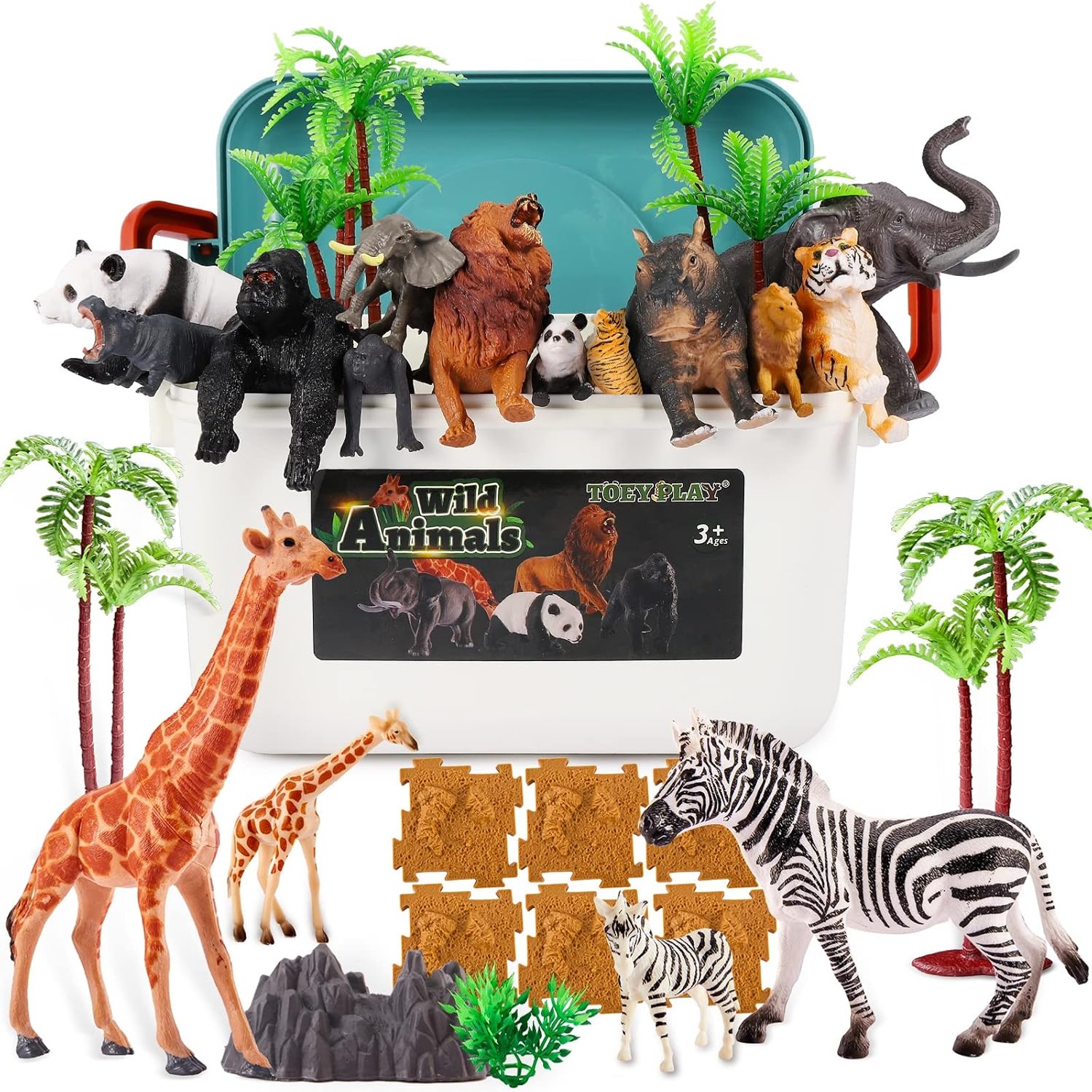
A 52 piece animal figures set with scenery and a case solves that in a very practical way. It gives children a floor to build, somewhere for the animals to stand, and one container that everything goes back into. That last part matters more than it sounds.
What is actually in the box
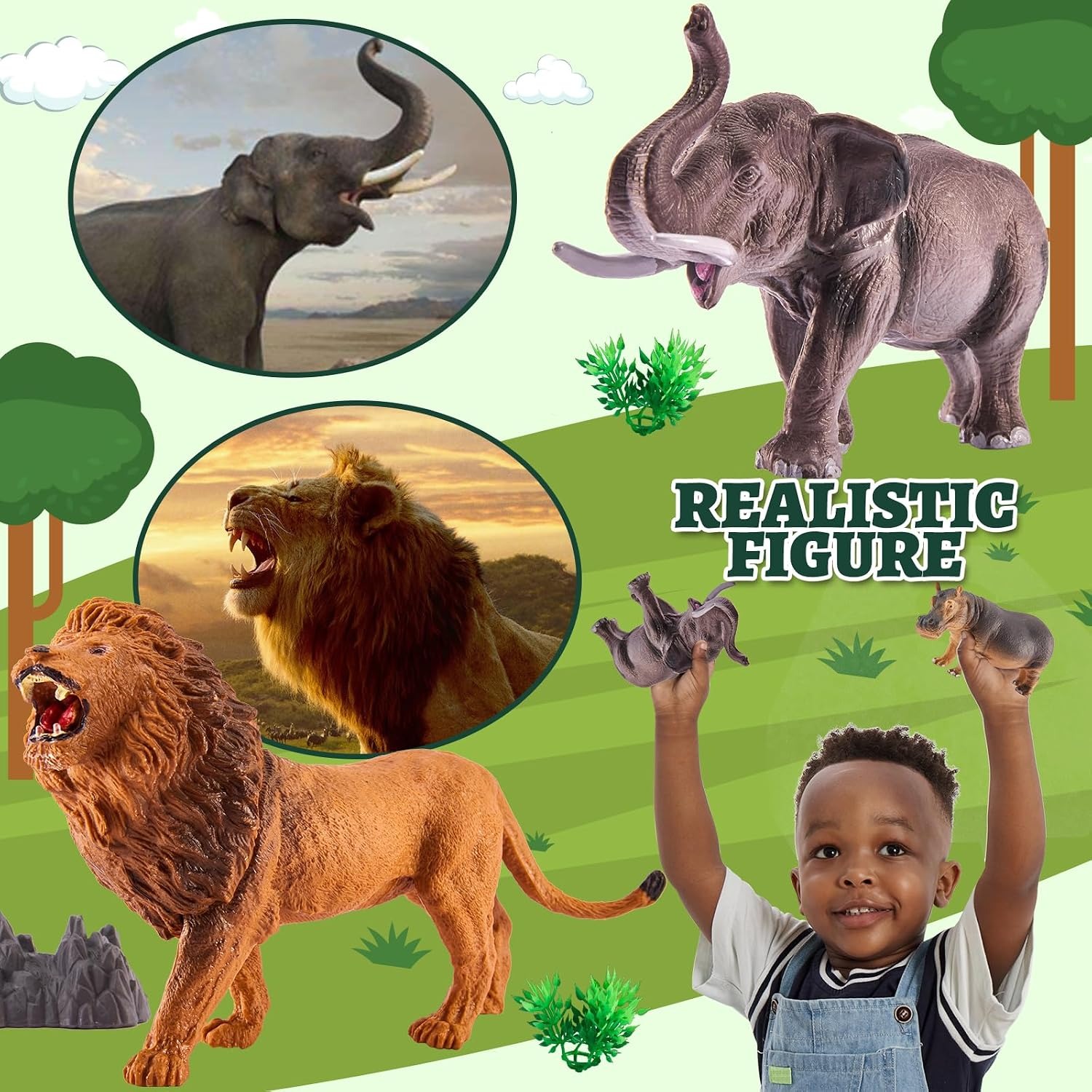
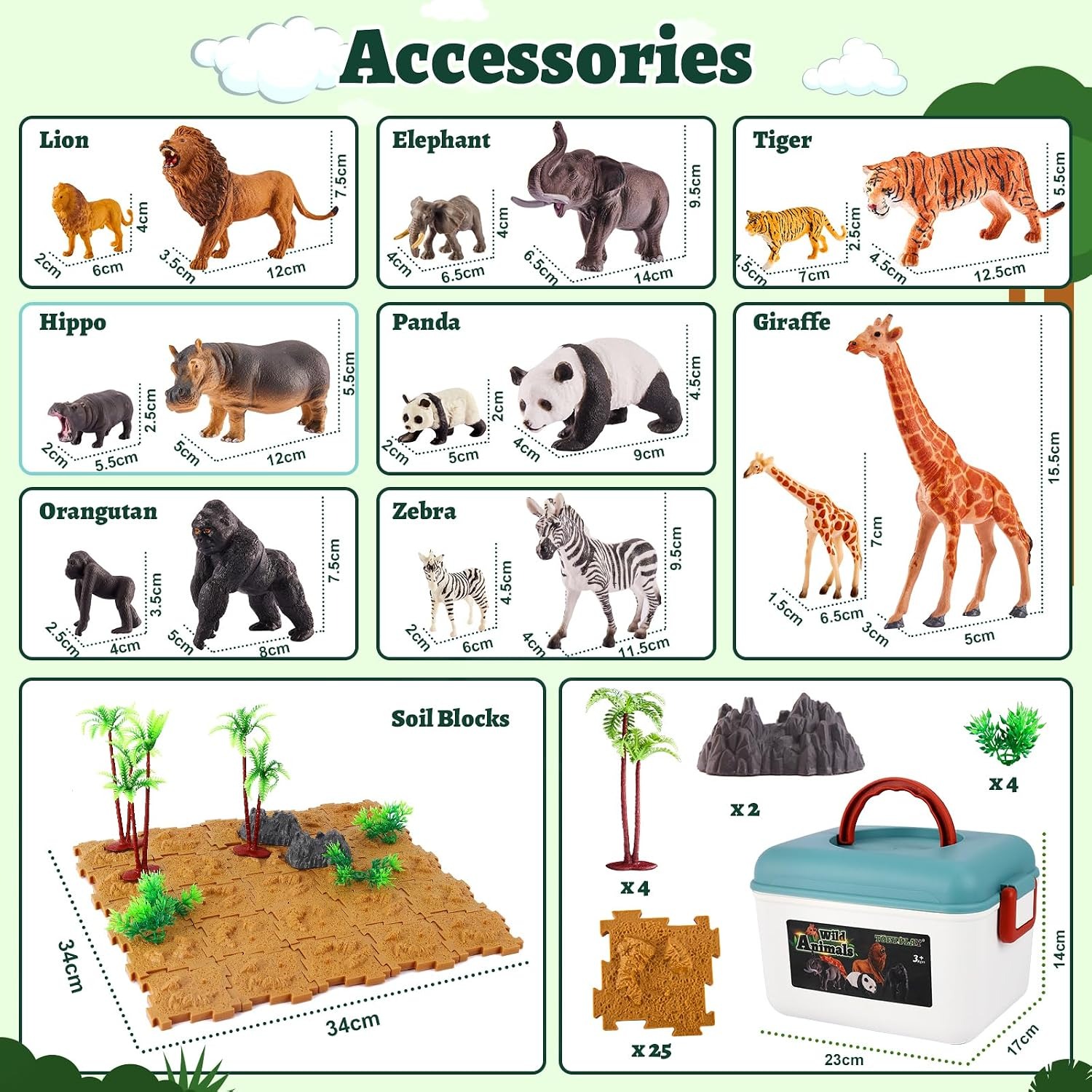
This set breaks down into four groups of pieces. There are eight animal mother and child sets, covering a lion, elephant, tiger, hippo, panda, orangutan, zebra and giraffe. There are 25 blocks moulded to look like patches of soil, which interlock at their edges. There are scenery extras, specifically four trees, three tufts of grass and two rocks. And there is the storage side of it, a carpet piece plus the moulded case itself.
Figures run roughly 8 to 14 cm, so a giraffe is noticeably taller than a hippo, just as it should be. The case measures 23 x 17 x 14 cm and has a handle. The whole thing weighs 0.98 kg packaged, which a school age child can carry without complaint.
The maker, TOEY PLAY, lists it for ages over 3 with a working range of 36 months up to about 10 years. Material is plastic, colour multicolor, made in China. Assembly is required in the sense that children build the scenery themselves, not in the sense that a parent needs a screwdriver on Christmas morning.
Why mother and baby pairs change the play
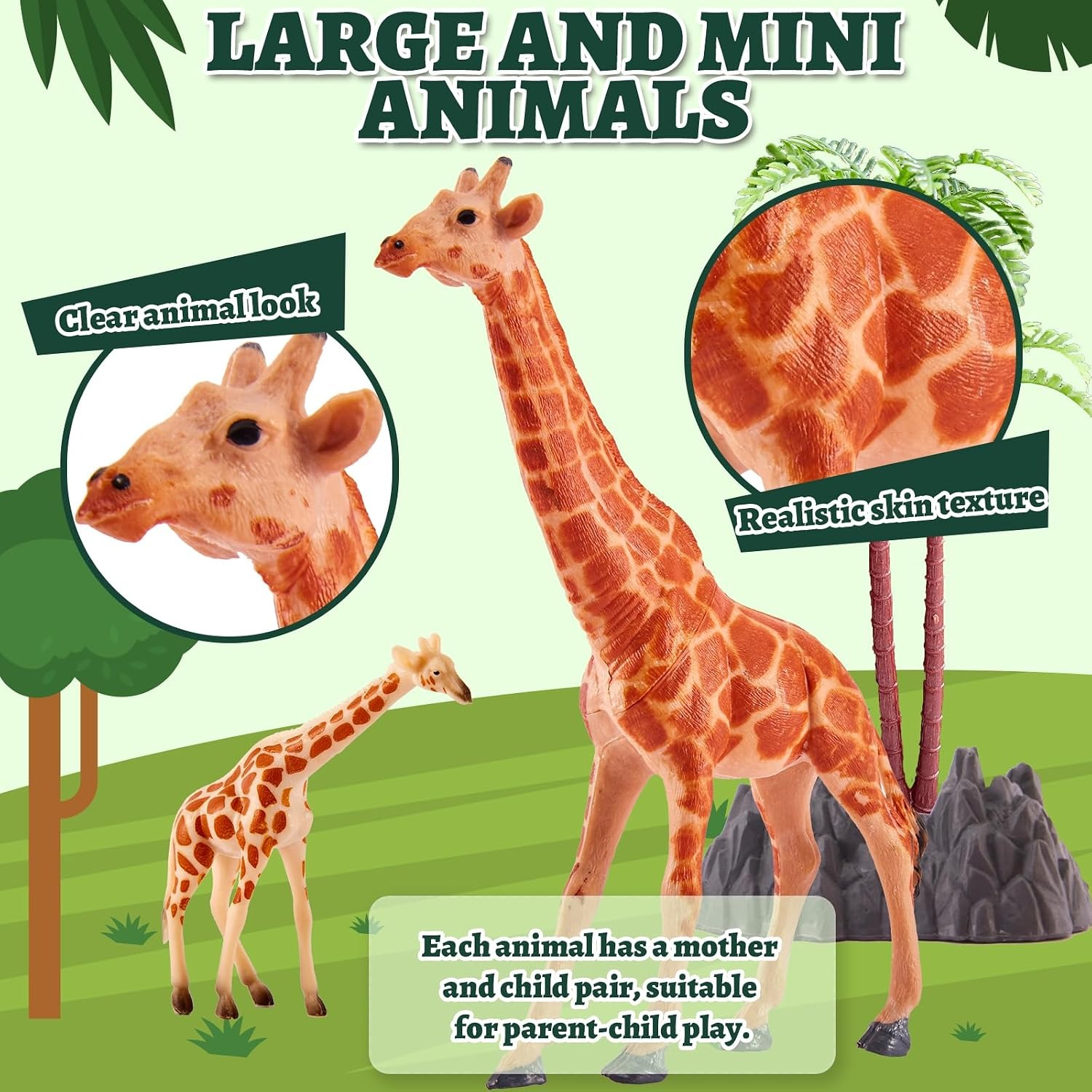
The pairing idea is quietly clever. Young children are drawn to matching before they are drawn to storytelling. Put sixteen animals on a rug and a three year old will often start by sorting them, big with small, stripes with stripes, grey with grey. That is real cognitive work dressed up as a game.
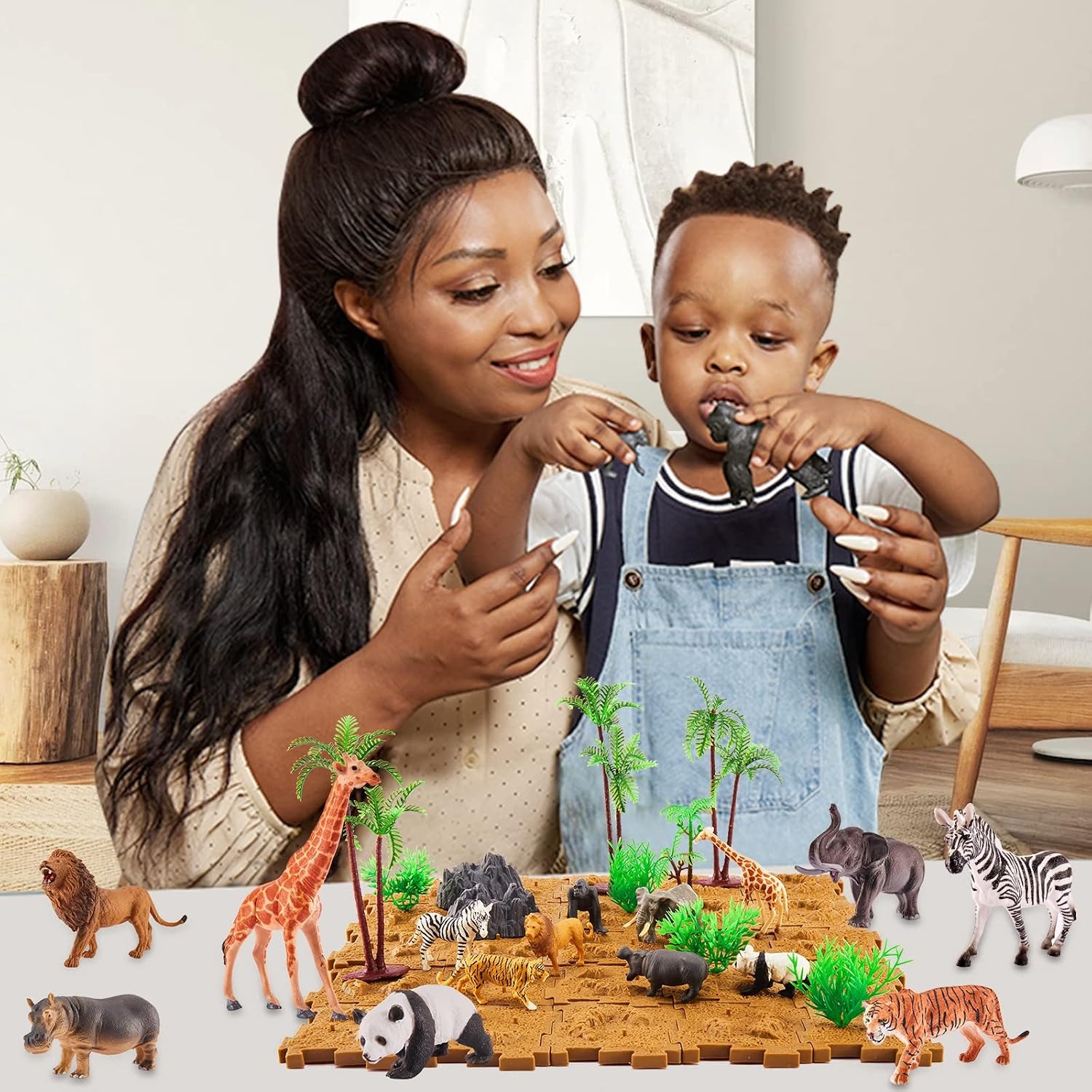
It also gives the play an obvious plot. The baby elephant wanders off. The mother goes to find it. The lion family moves to the shade. Children who freeze up when asked to "just play" often get moving once there is a relationship on the rug, and a parent and child pair is the easiest relationship for a small person to understand.
For slightly older children the pairs become a classification exercise. Why do the zebra and the tiger both have stripes but look nothing alike? Why is the panda black and white when it lives in a forest? You do not have to turn it into a lesson. The questions tend to come on their own.
The blocks are the part people underestimate
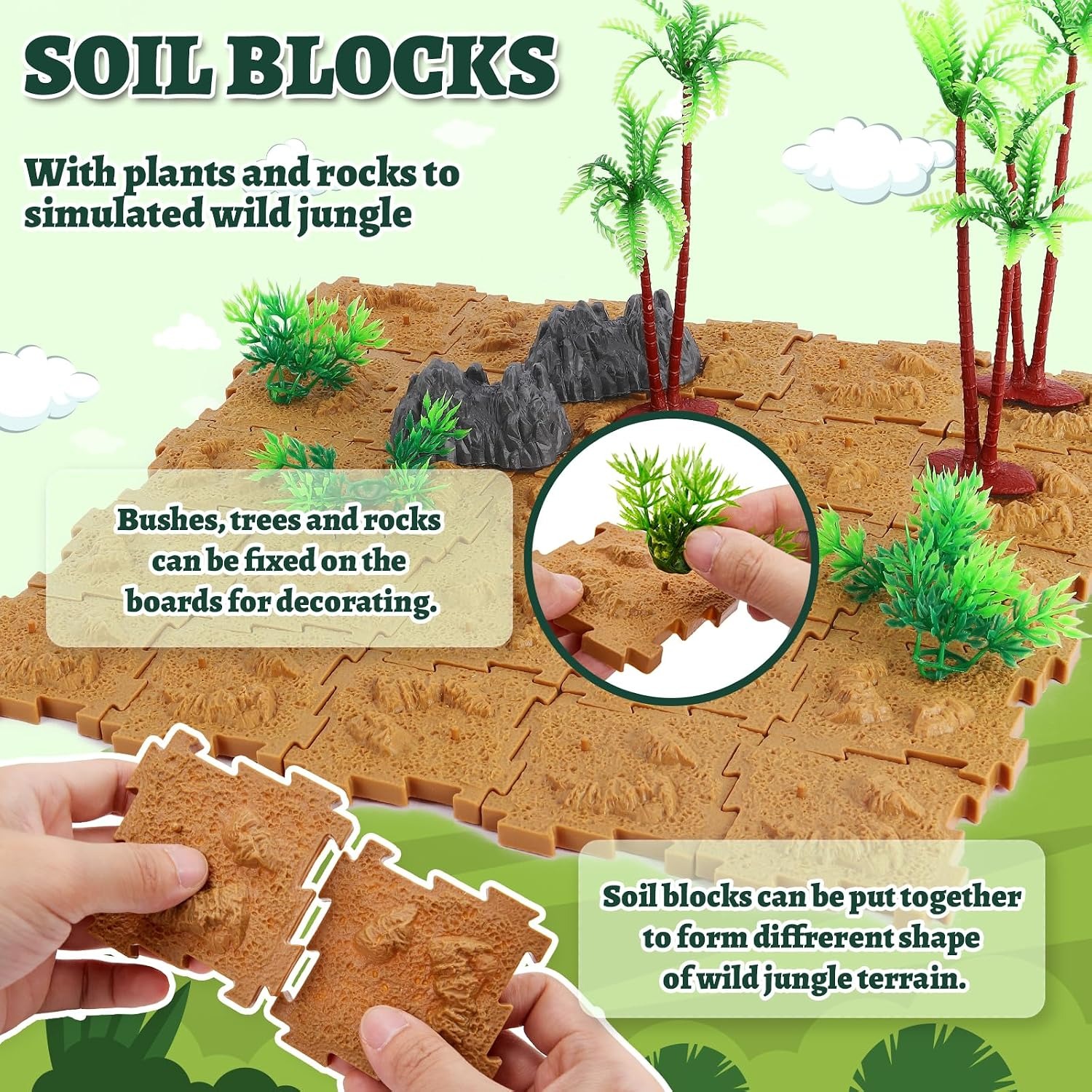
Twenty five interlocking soil blocks sound like filler until you watch a child use them. They give the set a footprint. Suddenly the animals are not floating on carpet, they are standing on ground with an edge to it, and that edge becomes a cliff, a river bank or the wall of a zoo enclosure.
Because the trees and grass fix into the blocks rather than balancing on top, the scene holds together. A child can build a layout in the kitchen and carry a section through to the lounge without it falling apart. That robustness against knocks is the difference between a landscape that gets built once and one that gets rebuilt every afternoon.
The blocks also play nicely with toys you already own. Dinosaurs, farm animals, small cars and toy people can all walk across them. If you are looking for the best animal toy set with scenery, that flexibility is worth more than a bigger headcount of figures.
Who it suits, and who it does not
This works best for children between about three and eight. At the younger end the appeal is carrying, naming and matching. At the older end children start building habitats with intent, separating the predators from the prey, giving each family a territory, and inventing rules about who can cross which block.
It is not right for under threes. The grass tufts and young animals are small enough to be a choking risk, and the age guidance of over 3 years exists for that reason. If your child still mouths toys, hold off for now.
It is also not a collector's display set. These are play figures with recognisable shapes and colours, not finely detailed museum models. If someone in your house wants anatomically precise wild animal figurines for a shelf, that is a different purchase. If you want figures that get dropped, carried outside and lined up on the sofa arm, this is the right category.
How to choose between animal sets
A few things actually predict whether a set gets used.
Storage comes first. A set with a proper case gets packed away and therefore survives. A set in a mesh bag gets scattered within a fortnight. If you only check one thing when comparing the best animal toys with carry case, check whether the storage is a real container with a handle or a flimsy drawstring.
Figure size comes second. Anything under about 5 cm is fiddly for small hands and easy to lose in a carpet. The 8 to 14 cm range here sits in a good spot, big enough to grip firmly and still small enough that sixteen of them fit in one box.
Third, look for scenery that attaches. Loose trees that fall over are a source of frustration. Pieces that lock into a base stay where a child puts them, which keeps the play going.
Finally, think about whether the set gives children something to do beyond holding a figure. Blocks to assemble, pairs to match and a layout to design all add minutes to the session. A bag of twenty identical-sized animals gives you one activity. This gives you several.
Looking after it
Care is simple. Wipe the figures and blocks with a damp cloth and a little mild soap when they get grubby, then dry everything properly before it goes back in the case. Skip the dishwasher and the washing machine, and keep plastic away from radiators and hot car dashboards so nothing warps.
Water play is usually fine for the figures themselves, but go easy with the blocks and the case, since moisture can sit in the joints. Sand is the real enemy, because grit works into the interlocking edges and makes them stiff. Indoor use plus dry garden play keeps the set in good shape.
The single most useful habit is counting pieces back into the case at the end of play. Make it part of the game. The child who puts the baby giraffe back with its mother is tidying up without realising it.
A quick word on gifting
Complete sets give better than loose toys. This one arrives in a case, so there is something solid to hand over, and the receiving child can see at a glance that there is a lot in there. For a birthday or holiday gift in the three to eight bracket it covers a good stretch of ages, which is handy when you do not know exactly what a child already owns.
If you are buying for a household that already has a mountain of figures, the blocks are still the selling point. New terrain refreshes toys they already have.
The short version
You get 52 pieces, built around eight animal mother and child pairs plus 25 interlocking soil blocks, four trees, three grass tufts, two rocks and a carpet, all in a 23 x 17 x 14 cm case with a handle. Figures measure about 8 to 14 cm. Recommended for over 3 years, with a working range up to around 10. Plastic, multicolor, made in China, 0.98 kg packaged.
What you are really buying is structure. The animals have ground to stand on, the scenery stays put, and everything has one place to live at the end of the day. That combination is why a set like this keeps getting pulled out long after a bag of loose figures has disappeared under the furniture.